Hotel Key Card Switch FAQ: Answers for Owners, Engineers, and Guests
A hotel key card switch FAQ answering what it is, which cards work, how to wire it, what it powers, safety rules, and how to troubleshoot it.

A hotel key card switch FAQ is a plain-language reference that collects the questions hotel owners, maintenance engineers, and first-time installers ask most often about a hotel key card switch, the wall device that powers a guest room only while a card sits in its slot. The device closes a 30A relay to feed lights, air conditioning, and sockets the moment a valid card is inserted, then opens that relay typically 15 seconds after the card is removed, so an unoccupied room stops drawing standby power. A hotel key card switch FAQ answers how the reader validates a card, which card types work, how the unit wires into a single-gang box, what loads the relay can carry, what the safety rules are, and how to troubleshoot a unit that will not release. Because the answers stay general and device-level, the same FAQ serves properties running different card systems without assuming any particular brand, and it works as a training sheet for staff.
Hotel Key Card Switch FAQ: What It Is
In this hotel key card switch FAQ the first question is simply what the device is and why a hotel installs one. A hotel key card switch is a flush-mounted wall panel, usually 86x86x48mm, placed beside the guest-room door, with a narrow slot into which the guest inserts the room card on entry. Inside the panel sit a card reader, a small microcontroller, and a large electromechanical relay rated around 30A on AC. When the reader accepts the card, the relay closes and power reaches the room; when the card leaves the slot, a timing circuit holds the relay for a preset delay, conventionally 15 seconds, then opens it and cuts power to the controlled circuit. The controlled circuit normally covers the lighting, the air-conditioning unit, and the wall sockets together, so a room that is empty stops drawing power for the biggest loads. Because nothing network-connected or remotely managed is required, the whole function happens locally in the panel, and it works even during a loss of mains supply because a card physically occupies the slot. This is why the device is a common first step in a manual room energy routine rather than a capital project.
Hotel Key Card Switch FAQ: How It Works
The working principle behind a hotel key card switch FAQ question is an insert-and-cut cycle that converts a physical card into a permission to draw power. The guest inserts the card face forward into the slot; the reader detects the card and reads its identifier, either a raw UID read from the memory chip or a guarded sector value, and passes that to the microcontroller. If the check passes, the controller energizes the coil of the 30A relay, closing the high-current contacts that sit between the room distribution point and the room load. The room now has live power and every connected appliance can run. At checkout the guest simply takes the card from the slot and the presence detector in the reader goes idle. The controller then runs its delay timer, keeping power alive for those 15 seconds so a guest is not plunged into darkness while collecting luggage, and at the end of the window it de-energizes the relay and the circuit opens. The whole sequence is local, deterministic, and repeatable, and it produces a repeatable pattern of dark-and-quiet rooms whenever the card is out.
Hotel Key Card Switch FAQ: Which Cards Work
A hotel key card switch FAQ must address compatibility because card technology is the main source of confusion for buyers. The reader inside the panel is built around a specific card standard, and that standard decides which cards the switch will accept. Universal models perform a UID-only read and accept any unencrypted M1 card, which is why many properties can start with cards they already own. RFID and TTLOCK models read MIFARE or Temic cards and compare a sector key or room identifier, so only the card assigned to that room will close the relay. This difference in reading logic changes behavior in one meaningful way: a universal unit will power the room with any M1 card, while an encrypted system rejects a card from another room. Card frequency matters too, with 125kHz contactless and 13.56MHz MIFARE being the two common families, and the reader must match the family of the cards already in circulation. For a hotel that has no card system at all, the universal model is the fastest path, while a property upgrading existing MIFARE cards should match the reader to those cards.
| Reader logic | Typical card | Room binding | What powers the room |
|---|---|---|---|
| UID-only (universal) | Any unencrypted M1 | None | Any reader-compatible M1 card |
| Sector key (RFID) | MIFARE / Temic | Room-specific | Only the room's assigned card |
| Sector key + time | TTLOCK MIFARE | Room + time window | The room's card within its stay |
| Frequency 125kHz | 125kHz contactless | Depends on logic | A matching 125kHz card |
| Frequency 13.56MHz | MIFARE | Depends on logic | A matching MIFARE card |
Hotel Key Card Switch FAQ: Wiring and Fit
Wiring and fit appear constantly in a hotel key card switch FAQ because most retrofits reuse an existing wall opening. The unit is designed for a standard single-gang junction box with inner dimensions around 74x74mm and a depth of about 48mm, with roughly 29mm of the panel body set into the wall. Wiring is simple: one live feed lands on the relay's common terminal, the switched outgoing line runs from the normally-open contact to the room circuit, and the reader and controller draw the small operating supply from the same feed. Because the 30A relay carries the full room load, an installer should confirm the room circuit breaker is rated below the relay, and for properties that want a dedicated high-current contactor, an external relay can be added and driven by the panel's control output. Voltage matters: standard units accept AC 180-250V, and a 110V variant exists for markets that need it. Wiring is adequately covered even when the room is wired with two or three wires, and the manual includes a labeling step so each panel's controlled circuit is traceable to a distribution point.
Hotel Key Card Switch FAQ: Safety and Load
Safety is the part of a hotel key card switch FAQ that most buyers ask about last but should ask about first, because a device that switches the whole room load needs a generous rating. The relay is specified at 30A on AC so that multiple appliances and fixtures can share one controlled circuit without overloading the contacts. An installer must add the rated currents of all controlled loads and keep the total below the relay rating and below the branch circuit rating. Because air conditioners and refrigerators draw a surge on start-up, the sum of continuous loads should be kept some margin below the relay limit rather than at it. The panel is made of flame-retardant ABS and inserts fully into the box so no live metal is exposed behind the faceplate. A fuse or a suitably rated circuit breaker in the room distribution protects the wiring, and the unit is engineered so that removing the card always defaults the circuit to the off state. If the room load will ever exceed the relay, an external contactor is the correct answer rather than a larger internal relay.
| Controlled load | Typical steady draw | Notes for sizing |
|---|---|---|
| LED room lighting | 0.05-0.2A | Small share of the relay budget |
| Split AC unit | 3-9A | Largest single load, watch start-up surge |
| Wall sockets (TV, kettle) | 0.1-3A | Sum text per socket |
| Refrigerator / mini-bar | 0.5-1.5A | Frequent motor start surge |
| Electric water heater | 8-13A | Validate against branch rating first |
Hotel Key Card Switch FAQ: Guest Experience
A hotel key card switch FAQ also covers the guest side, because how the device behaves in daily use determines staff patching and guest satisfaction. The guest inserts the card on entry, and within about a second the room lights come on; no button, code, or app is needed. On leaving, the guest takes the card and the 15-second delay keeps the room lit and powered long enough to step out and lock the door, then everything switches off. A guest who removes the card and quickly returns will see the room restart; each insert restarts the full cycle. If a guest leaves the card in the slot during the day for the cleaner or for convenience, the room simply stays powered, which is a behavior worth stating in arrival instructions. Some guests assume the card is needed for the door lock as well, but the switch and the lock are separate devices, and the switch only cares about a card present or absent in its own slot. The device never changes how the guest uses room keys; it only adds one small insertion step at the door.
Hotel Key Card Switch FAQ: Troubleshooting
Troubleshooting is where a hotel key card switch FAQ earns its keep, because most faults are simple once the sequence is understood. If the room has no power after a card is inserted, the first check is the relay and the branch breaker, not the panel. Confirm the controlled circuit is on, then insert a known-good card and listen for the relay click; a silent unit points to a reader or supply fault. If the room will not power down when the card is removed, the delay timer may be mid-count, and the correct procedure is to wait the 15 seconds before judging the unit. If a unit refuses a card that works elsewhere, the card is probably not assigned to that room or is from a different card family. If the relay closes but half the room stays dark, the fault is downstream at a socket or fixture, not at the switch. A panel that gets warm under load usually means the total draw is too close to the relay limit. Most diagnostics reduce to confirming supply, confirming card, confirming click, and confirming downstream.
Hotel Key Card Switch FAQ: Choosing a Model
Model choice is the closing decision in any hotel key card switch FAQ and it should be driven by the cards and habits already in the building. A property with no card system, or with a stack of mixed unencrypted M1 cards, should choose a universal model that reads any M1 card and requires no reprogramming. A property that already issues per-room MIFARE or Temic cards should choose an RFID energy-saving unit so that no card can power two rooms at once. A property that has installed electronic room locks from the TTLOCK family should choose a TTLOCK-compatible unit that reads the same cards and adds a stay-based time limit. A connected-rooms program that wants usage data should choose a BLE smart model that unlocks by phone and records activity. Because every model shares the same 30A relay, the 15-second delay, and the same 86x86x48mm panel, the switch decision never changes the electrical install; it only changes how strictly power is tied to a card. Local voltage and the number of panels per floor are the final factors to write into the quote.
Hotel Key Card Switch FAQ: Install Checklist
A hotel key card switch FAQ ends with a practical install checklist so the answers translate into steps on site. Before cutting any feed, confirm the local voltage and pick the correct variant, then turn off the room at the distribution point and verify with a tester. Land the live feed on the relay's common terminal and connect the switched outgoing line from the normally-open contact to the room circuit, keeping the control pair tidy. Mount the panel into the single-gang box, seat it flush, secure it, and label the controlled circuit so maintenance can trace it. Insert a known-good card and confirm the relay clicks within about one second and the room powers up. Remove the card and time the delay, confirming the circuit opens after the 15-second window. Repeat the test with the room's actual card, and finally run a load test on a dummy lamp before handing the room to a guest. A short entry in the room log noting the panel model and date completes the job and gives the next technician a clean starting point.
Hotel Key Card Switch FAQ: Delay and Timing
Timing is a subtle point in a hotel key card switch FAQ because guests and staff both notice the seconds after the card leaves the slot. The factory delay is normally 15 seconds, and it exists so that a guest who pulls the card and reaches for the door handle is not suddenly standing in darkness. During that window the relay stays closed and the room remains powered, then the controller opens the circuit. The delay is a fixed timer, not a sensor, so it does not try to detect whether anyone is inside; it simply counts from the moment the card is removed. A property that prefers a longer or shorter window can order units with a different preset, because the timing is set at production rather than field-adjusted on most models. Staff should explain to a guest that the lights may stay on for a few seconds after the card is taken and that this is normal. If a guest watches a room stay dark immediately on card removal, the unit may have a zero-delay setting or a fault, and the delay spec should be checked against the order sheet. The timer is the small piece of behavior that shapes the whole guest perception of the device.
Hotel Key Card Switch FAQ: Power Consumption of the Panel
A hotel key card switch FAQ occasionally gets asked how much power the panel itself uses, and the honest answer is that the panel is a negligible load because the reader and controller run on a small internal supply. The microcontroller and the card reader draw only milliamps while idle, and the relay coil is energized only while a card is present. In the resting state, with no card in the slot, the unit draws just enough to keep the controller alive and to sense card insertion, a fraction of a watt. In the active state, with a card inserted and the relay closed, the coil adds its own small draw, still far below the wattage of even one LED lamp. This matters to an energy discussion because the device does not trade one big load for another; the panel's own consumption is effectively invisible against the room loads it controls. Any estimate of the value of switching a room off should count the panel's draw as near zero and attribute the saving to the lighting, air-conditioning, and sockets that stop running. The engineering takeaway is that a hotel key card switch FAQ should reassure readers that the cure is not costlier than the complaint.
Hotel Key Card Switch FAQ: Mains vs Low-Voltage Panel
One recurring hotel key card switch FAQ distinction is between a mains-voltage panel that switches the room directly and a low-voltage panel that drives an external relay or contactor. The mains unit contains the 30A relay itself and switches the full room circuit from inside the 86x86x48mm panel, which is the common choice for most retrofit rooms. A low-voltage or control version instead carries a control pair to a separate contactor mounted in the distribution board, useful when the room load is very large, the wiring distances are long, or the property already uses contactors for other reasons. The two approaches feel identical to the guest; only the enclosure of the switching element differs. The decision between them depends on the room's electrical layout and the capacity of the existing distribution point. For the majority of guest rooms, the mains unit is simpler, cheaper to install, and fully adequate. A hotel key card switch FAQ should help an installer recognize when the low-voltage route is warranted rather than merely assuming the box always contains the high-current relay.
Hotel Key Card Switch FAQ: Multiple Card Swipes
Multiple card swipes is a practical hotel key card switch FAQ topic because a guest often carries more than one card, or a family shares a room. A universal unit reads any unencrypted M1 card, so a guest who inserts a second card from the same room will also power the room, and even a card from another room in a universal installation may work because the check is only that a card is present. An RFID unit bound to a specific room will accept the room's own assigned card and reject a card from another room, which is the behavior a property chooses when it wants to stop one card from powering several rooms. Multiple legitimate cards for the same room are normal and all of them will work, because binding is to the room, not to a single physical card. The question of whether a card should power more than one room is exactly the decision between a universal and an encrypted reader. A hotel key card switch FAQ should state plainly that universal means permissive and encrypted means per-room, and let the property choose the strictness it wants.
Hotel Key Card Switch FAQ: How It Helps Save Energy
The energy question sits at the heart of a hotel key card switch FAQ because the device exists to cut wasted power on empty rooms. The mechanism is simple: a room with the card out has no path for the controlled circuit, so the lighting, the air conditioner, and the sockets cannot run. The air conditioner is the dominant load in most climates, and an AC left running in an empty room draws continuously until someone turns it off or a switch cuts it. The switch removes the need for a guest or a cleaner to remember to turn things off at checkout, because the moment the card leaves the slot the circuit is opened after the short delay. The result is that empty rooms are dark and quiet by default rather than by discipline. It is important to frame this correctly: the switch does not make any appliance more efficient, it only ensures appliances do not run when no one is in the room. The saving is therefore proportional to how often a room would otherwise be left powered while empty, and it is driven by the interval between checkout and the next cleaning or guest arrival.
Hotel Key Card Switch FAQ: Housekeeping and Staff Bypass
Housekeeping is a real concern in a hotel key card switch FAQ because cleaners need power to work in a room that may be booked for the next guest. When a housekeeper enters a vacant room to clean, the room is dark because no card is in the slot, and the cleaner needs lights and possibly power for equipment. The common answer is that housekeeping carries a service card that is valid for the slot, and inserting that card powers the room for the duration of the clean, then the card is removed and the room powers down again. Properties that want to keep cleaning power separate from guest power can wire the sockets so that they are not on the controlled circuit, leaving lighting and AC on the switch while cleaning outlets stay live. The choice between these two layouts depends on whether the property prefers a single clean shut-off or a persistent cleaning supply. A hotel key card switch FAQ should acknowledge the housekeeping workflow explicitly, because a device that ignores the cleaner will be bypassed in the field, and a device that fits the workflow becomes part of daily routine without resistance.
Hotel Key Card Switch FAQ: Retrofitting Existing Rooms
Retrofitting is the most common deployment in a hotel key card switch FAQ because few properties are built around the switch from day one. The retrofit begins by checking the existing wall opening, because most rooms already have a light switch or an outlet box in a 86x86 form factor near the door. If the opening matches a single-gang box, the panel drops in directly with no carpentry. If the room has no suitable box near the door, a short surface or flush box is added, which is the only part of the job that touches the fabric of the room. The controlled circuit is identified at the distribution board so the installer knows which branch the relay will switch, and the panel is wired with the live feed and the switched outgoing line. Because every model uses the same 30A relay and the same panel, retrofitting does not depend on the card system; the same box accepts a universal, RFID, TTLOCK, or BLE unit. A hotel key card switch FAQ should end this point by noting that the electrical work is identical to replacing a switch and is within the scope of a qualified electrician on site.
Hotel Key Card Switch FAQ: Ordering and Quantity
The ordering question closes a hotel key card switch FAQ with the numbers a buyer needs before sending a request. Quantity is driven by the number of guest rooms that need a panel, plus a spare margin for testing, labeling, and future repairs, with a small percentage held as spares being a common planning habit. The order should state the local voltage, the panel finish such as white or silver, the card logic required, and the delay setting if a non-standard timing is wanted. A sample unit is usually ordered first so the buyer can test it against the room's real cards and a real load before committing the whole property. The order line should confirm the relay rating so the electrician can match the branch circuit breaker. Because panels ship for a shared 30A relay platform, a property can standardize on one model and keep a single spare card on every floor. A hotel key card switch FAQ that covers ordering turns a technical guide into a complete procurement sheet, so the reader can leave with both the how and the what-to-buy answered.
Hotel Key Card Switch FAQ: Sockets and Priority Loads
Sockets are a detail that often surprises readers of a hotel key card switch FAQ because not everything in a room should sit on the switched circuit. The relay controls whatever branch the installer routes through it, and the property decides which outlets share that branch. Lights and the air conditioner are the two loads that most properties want switched, because they are the largest and the most often left running. Wall sockets for a television, a phone charger, or a kettle are usually also switched so they go dead with the room. There is one class of socket that many properties deliberately keep off the controlled circuit: the one serving a mini-bar refrigerator or a small appliance that must stay powered for safety or stock. A refrigerator that is cut off at checkout would let perishable stock thaw, so its socket is wired ahead of the switch. The same thinking applies to a telephone base or a smoke detector, which must remain powered regardless of the card. A hotel key card switch FAQ should therefore frame the question as what to switch and what to protect, rather than assuming the whole room goes dark.
Hotel Key Card Switch FAQ: Seasonal and Climate Loads
Seasonal loads enter a hotel key card switch FAQ because the value of switching changes with the weather. In a hot climate the air conditioner is the dominant guest-room load, and an AC left running in an empty room between checkout and cleaning is pure wasted draw for hours at a time, so the switch prevents the longest and costliest kind of waste. In a temperate season the heating or cooling load is smaller, and the lighting and socket loads become a larger share of what the switch removes, which lowers the daily impact of the device but does not change the principle. In a cold climate a room with the card out simply stops the heater, and a heater left running in an empty room is a real concern both for waste and for safety. A hotel key card switch FAQ that acknowledges climate helps a buyer set expectations: the device is always doing the same job, but the size of the effect tracks how much power the room would otherwise draw while empty. This is why the same panel is specified in very different regions; the hardware is universal, and only the magnitude of the result moves with the season.
Hotel Key Card Switch FAQ: Panel Health and Longevity
Panel health is a maintenance angle in a hotel key card switch FAQ that owners rarely see before the first unit fails. The electromechanical relay is the only moving part, and its contact life is measured in cycles of opening and closing rather than years of wall time. Each checkout-and-check-in pair is one or two operations, and a busy room produces a modest number of cycles a day, which keeps the relay well within its rated life over many years. The card slot and the reader face occasional physical wear from cards being pushed in and pulled out thousands of times, and the slot should be kept free of debris. The panel itself needs no routine service beyond the same cleaning a light switch gets. When a relay does reach the end of its contact life, the symptom is usually a room that intermittently loses power or fails to power up, and the fix is replacement of the panel rather than repair of the contacts. A hotel key card switch FAQ that covers longevity reassures a buyer that the device is a long-life component with a single, predictable wear point, not a fragile piece of electronics.
Hotel Key Card Switch FAQ: False Power and Partial Rooms
False power and partial rooms are the failure patterns that a hotel key card switch FAQ should help a technician read quickly. A false-power symptom is a room that stays lit or powered when no card is present, and it usually traces to a relay whose contacts have welded shut, or to a circuit that was wired ahead of the switch by mistake. A partial-room symptom is one where the lights come on but the sockets stay dead, or the reverse, and it almost always points to wiring that splits the room across more than one branch, only one of which passes through the relay. Both patterns are diagnosed at the distribution board rather than at the panel, because the relay can only cut what flows through it. The test is to remove the card, confirm the relay opens, and then walk the room checking each socket and fixture to map which branch is controlled and which is not. Once the branch map is clear, the fix is either rewiring a branch into the switched circuit or replacing a worn relay. A hotel key card switch FAQ that teaches this read is more useful than a parts list.
Hotel Key Card Switch FAQ: Planning a Property-Wide Rollout
A property-wide rollout is the scale at which a hotel key card switch FAQ becomes a management plan rather than a single-room job. The first step is a survey that walks every guest room, records the wall opening near each door, identifies the controlled branch at each distribution board, and notes the local voltage and the card family in use. From that survey a project manager derives the model to standardize on, the quantity to order with spares, and a wiring diagram that is consistent floor to floor. The install is then scheduled room by room so that only rooms already vacated are touched, and each completed room is tested with the real room card before it is returned to inventory. Staff are trained on the housekeeping service card and the delay behavior so that the rollout does not create a support desk of questions. A short room log notes the panel model, the install date, and the technician, which makes later troubleshooting trivial. Because the hardware is identical across models, the rollout can begin in one wing and be extended without re-engineering, which is exactly why a property-wide plan in a hotel key card switch FAQ is more a logistics exercise than a technical one.
Hotel Key Card Switch FAQ: Procurement and Supporting Documents
Procurement paperwork is the last practical layer of a hotel key card switch FAQ, because a buyer eventually needs to turn the technical answers into a request for quote. The supporting document should state the quantity by room, the operating voltage, the required card logic, the panel finish, and the relay rating, and it should attach a room wiring diagram so the supplier quotes the correct model. A buyer should ask for a sample unit as part of the first order so the panel can be tested against the room's actual cards and a representative load before the full quantity is committed. The request should also confirm the lead time that fits the renovation schedule, because ordering after the electrical work is booked creates avoidable pressure. For a property standardizing on one model, the quote can be written as a single line for the panel plus a spare ratio, which keeps the math simple across the fleet. A hotel key card switch FAQ that closes with procurement lets the reader move from understanding the device to actually buying it, which is the point of a practical reference.
Part of this article content is generated by AI and optimized for professional accuracy and readability.
Not sure which sensor fits your project?
Talk to our mmWave application engineers for a free consultation.
Find the right presence sensor for your hotel project
Compare the 3 protocols, check hotel-specific case studies, and download the installation guide
Related products
2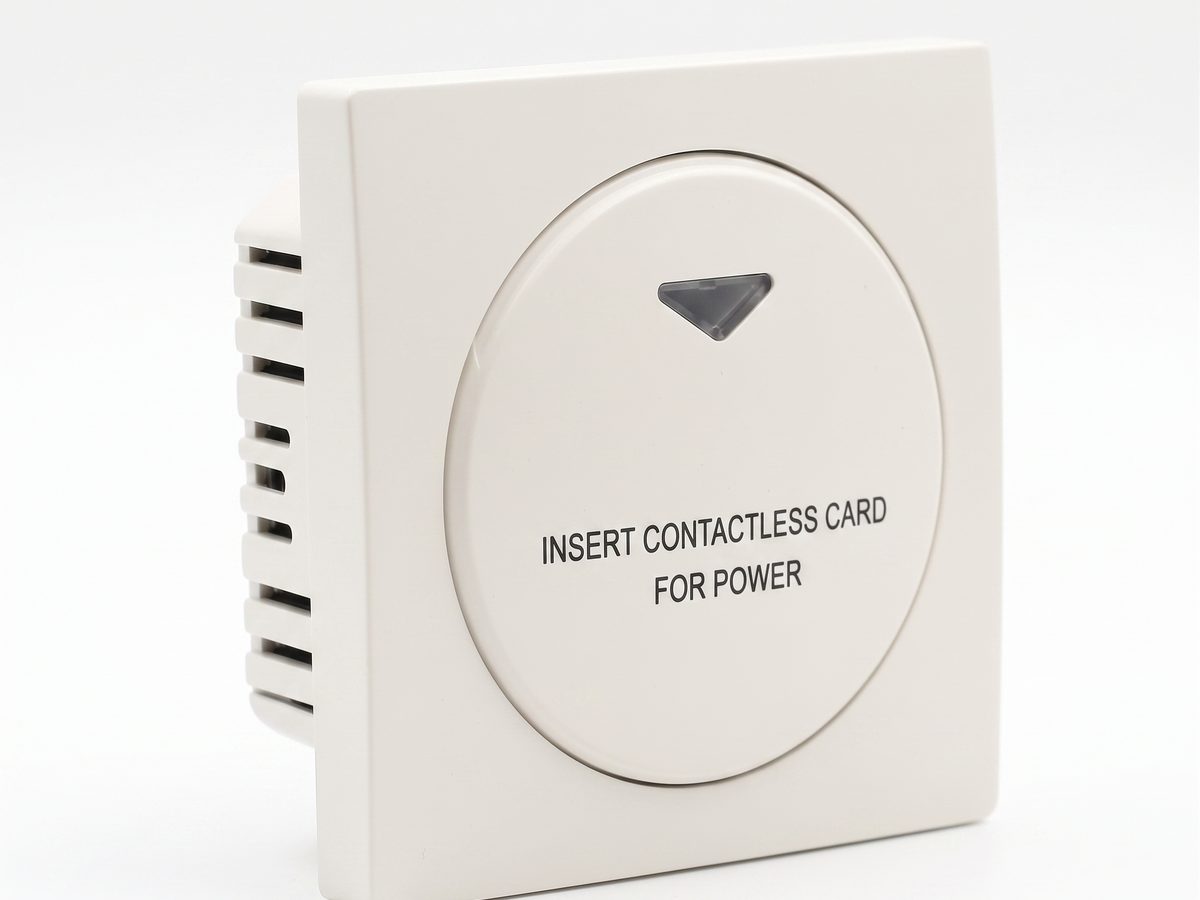
Hotel Key Card Switch — Guest Room Power Control
Hotel key card switch for guest room power control. RFID/IC card detection, insert-and-power, card removal time-delay power-off. 220V AC, 10A-16A, RS485 or dry contact. CE RoHS. OEM/ODM supplier.
This page already points to it as the next recommended reference.
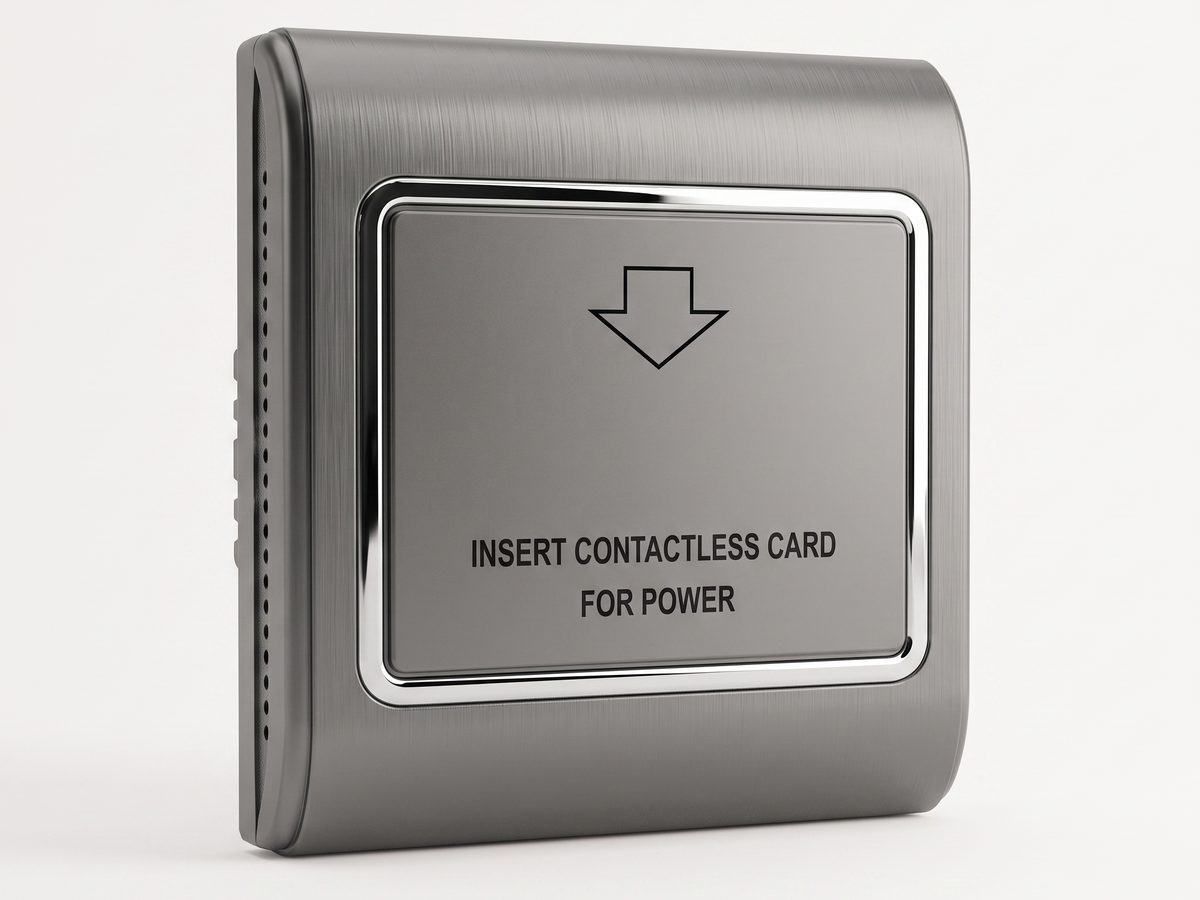
RFID Energy Saving Switch — Room-Bound MIFARE Card Switch (Type B)
RFID energy saving switch that binds power to a specific room MIFARE card. 13.56MHz MIFARE / 125kHz Temic, AC 180–250V, 30A, 15s delay-off. An RFID hotel switch that stops card-sharing between rooms and cuts 25–40% room energy.
This page already points to it as the next recommended reference.
Related solutions
3Guest Room Management System Based on Card-Controlled Power
A practical guest-room management system for controlling room power through key card switches, contactors, and clearly documented operating rules.
It supports the same product context: Hotel Key Card Switch — Guest Room Power Control, RFID Energy Saving Switch — Room-Bound MIFARE Card Switch (Type B).
Hotel Energy Saving with Guest-Room Power Switching
A hotel energy-saving solution that uses card-controlled room power to prevent lights, air conditioning, and selected outlets from running unnecessarily.
It supports the same product context: Hotel Key Card Switch — Guest Room Power Control, RFID Energy Saving Switch — Room-Bound MIFARE Card Switch (Type B).
Hotel Room Power Control with Key Card Switches
A practical hotel room power control solution for switching guest-room lighting, air conditioning, and outlets from an authorized room card.
It supports the same product context: Hotel Key Card Switch — Guest Room Power Control, RFID Energy Saving Switch — Room-Bound MIFARE Card Switch (Type B).
Related blog posts
3
Hotel Key Card Switch: Types, Models, and How to Specify
A hotel key card switch spans universal, RFID, TTLOCK, BLE, and occupancy models. This guide to the key card / keycard switch family covers the head terms —…
It supports the same product context: Hotel Key Card Switch — Guest Room Power Control, RFID Energy Saving Switch — Room-Bound MIFARE Card Switch (Type B).

RFID vs NFC for Hotel Key Card Switches: Which Card Tech to Choose
RFID vs NFC for hotel key card switches comes down to range and lock-in: 125kHz / 13.56MHz RFID (MIFARE, Temic) is the hotel standard for room-bound power…
It supports the same product context: RFID Energy Saving Switch — Room-Bound MIFARE Card Switch (Type B), Hotel Key Card Switch — Guest Room Power Control.
What Is a Hotel Key Card Switch and How It Saves Room Energy
A hotel key card switch is a wall device that powers a guest room when a card is inserted and cuts it when removed, typically saving 25–40% of room…
It supports the same product context: Hotel Key Card Switch — Guest Room Power Control, RFID Energy Saving Switch — Room-Bound MIFARE Card Switch (Type B).
Specify your hotel project with our engineers
Send your room count, ceiling type, and protocol preference. We will return a sample plan and quote within 24 business hours.
- Move from general guidance into a product or application discussion.
- Use RFQ when pricing, drawings, MOQ, or launch timing needs structure.
- Keep a direct contact path visible for fast clarifications and handoff.