Why choose a hotel energy saving switch
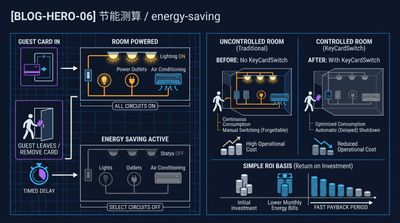
A hotel energy saving switch is a guest room power control device with one job: keep powered loads off when a room is empty. It powers the room when a guest inserts a key card and cuts power after a card-removal delay when the guest leaves. For hotel owners and finance teams, this hotel energy saving switch targets the single largest operating cost that can be automated — HVAC and lighting running in unoccupied rooms. Because a room is occupied by definition only while a guest card is present, the energy saving switch gives a deterministic signal that motion sensors cannot match, and it requires no network, no app, and no staff behaviour change to save energy.
How a hotel energy saving switch saves energy
The energy-saving logic of a hotel energy saving switch is simple and measurable. On arrival, the guest inserts their key card, and within 0.5 seconds the switch closes its relay, powering lighting, sockets, HVAC, and any other loads wired to the controlled circuit. When the guest leaves and removes the card, the switch starts a selectable delay of 15s, 30s, or 60s before opening the relay. Because the delay is short compared with the many hours a room sits empty, the energy saving switch effectively ensures controlled loads run only while the guest is in the room. Engineering teams typically measure a 20-40% reduction in room-level electricity cost after retrofitting key card energy switches, with the investment recovering within months in high-tariff regions.
Working with HVAC for maximum efficiency
The value of a hotel energy saving switch is multiplied when it works with HVAC. The power-off delay is engineered to let the air conditioning compressor complete a graceful shutdown, avoiding the short-cycling that damages compressors and shortens equipment life. In rooms with high-power air handlers or water heaters, the switch's dry contact output drives an external contactor, keeping switch contact wear low while handling large loads. By defining the controlled circuit at installation, the energy saving switch can be scoped to cover ventilation and air handling alongside lighting and sockets, so the entire room's energy profile follows the guest's presence.
Deterministic control versus motion-based sensing
A hotel energy saving switch differs fundamentally from motion-based occupancy control. Motion sensors register movement from any source — cleaning staff, sunlight, or a room that simply has air moving through it — and they can keep ventilation running long after a guest checks out. A card-based hotel energy saving switch powers the room only while a guest card is present. There is no false trigger, no sensitivity calibration, and no occupancy timeout that risks cutting power to a guest who is sitting still. For hotel operators who want reliable, predictable energy control, the key card energy switch is the more robust choice.
Key specifications of the hotel energy saving switch
This hotel energy saving switch operates on AC 100-240V, 50/60Hz for global voltage support, with an internal relay rated 10A or 16A resistive and 8A inductive, handling up to 3500W of connected load. Standby power draw is below 0.3W when no card is present, so the switch does not offset its own savings. It accepts standard IC and RFID guest key cards, fits a standard 86-box wall mount, and offers a flush white face plate or custom OEM finishing. The optional RS485 port provides a path to centralized guest room power control and building management systems.
Compatibility with existing hotel infrastructure
This hotel energy saving switch is designed to work within an existing hotel without disruption. It works alongside any door lock brand, including Onity, VingCard, Assa Abloy, and SALTO, with no integration work, and accepts standard guest cards without reissuing media. The 86-box mount fits standard junction boxes, so retrofit replaces an existing wall switch in minutes with no rewiring of the room. For hotels rolling out centralized energy reporting, the RS485 port and dry contact output offer clean integration points.
OEM and ODM capability
As an OEM/ODM supplier, we tailor the hotel energy saving switch to brand and project requirements: face plate color and logo, power-on/power-off timing, relay rating, RS485 protocol, and packaging. Minimum order quantity is 100 pcs with samples available in 5-7 days and mass production in 15-25 days. We ship worldwide on FOB Shenzhen, CIF, DDP, or EXW terms and support T/T, L/C, and Trade Assurance payment, with every unit carrying CE, RoHS, and ISO 9001 compliance.
How to get a quotation
Tell us your room count, target loads (lighting, sockets, HVAC, water heater), current tariff or target payback period, and whether you need RS485 or dry contact output. We will return a per-room cost, expected annual saving estimate, integration diagram, and sample plan within 24 business hours.